Science of the Renaissance: COSi at ORF
When we look at the past, we tend to do so with an eye for criticism and a sense of superiority for the knowledge that is now considered common sense. Of course, we know to wash our hands to prevent the spread of germs! And who, in this day and age, would ever believe that lavender shoved into the beak of a mask could prevent plague miasma! Laughable, right?
What we fail to see through our 21st century lenses that, to a person of the 16th century with their amassed understanding of how the world works, these actions made perfect sense. The people of the past were not stupid. They possessed the same amount of intelligence as we do now, but they were often limited by their access to knowledge and resources. The misgivings of the Church often halted scientific progress if it went against accepted doctrine. Prior to the invention of the printing press (Gutenberg, 1440) finding documentation from other sources was difficult to achieve.
It was during the Renaissance that a definitive expansion of science began to produce results on multiple fronts. Not necessarily factual or even accurate results, but such is the nature of antiquity and social/religious repression. For the first time in ages an interest in anatomy, geography, mathematics, and astronomy gained rapid popularity in both esoteric and public circles. While their studies may have been based on medieval guiding principles, they nonetheless paved the way for the scientific revolution that would come later.
Medieval Sciences: Reconstruction and Revitalization
When you imagine the “Dark Ages” of Europe, what comes to mind? Filth, perhaps. Muck and misery in ample supply. Ignorance and blind faith clinging desperately to the hope of a better afterlife.
What you must understand about medieval science is that it did not happen in a bubble. Greek manuscripts which detailed the discoveries of the ancient world were nearly impossible to obtain. The study of Roman texts leads towards a pervasive belief in natural philosophy, in which a research-based approach to the natural and physical world from a perspective of logic and reason.
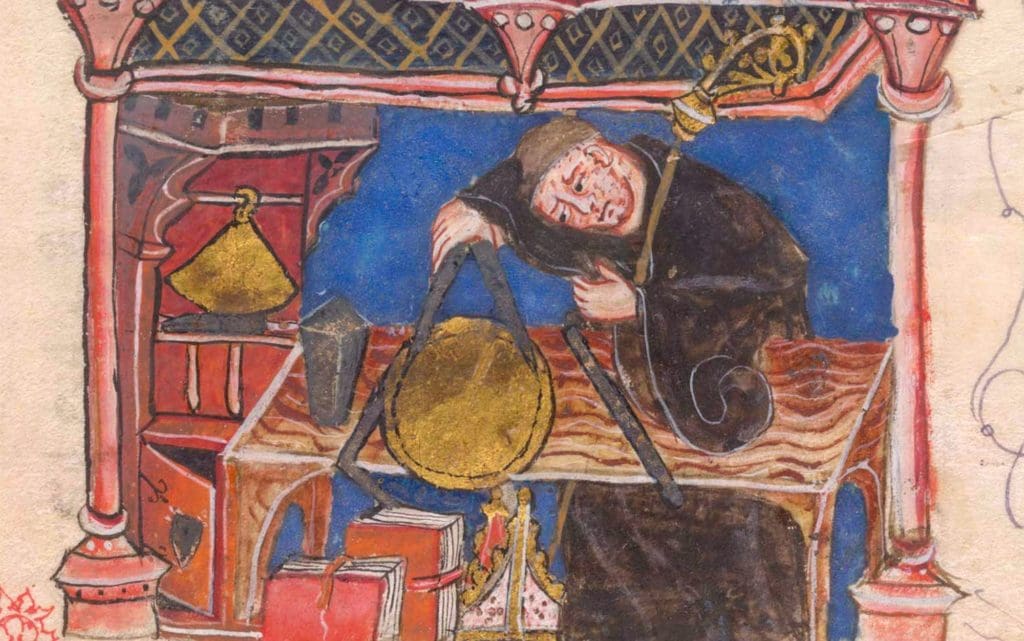
To medieval scientists’ matter was composed of four elements; earth, air, fire, and water, of which everything was comprised. The Earth was the center of the universe and had only three land masses; Africa, Asia, and Europe. The cosmos, its stars and heavenly bodies, could affect world events and human interactions. Math and astronomy were the language of God, and through its understanding one could understand the natural order of the universe. Human beings, the zenith of all creation, and their health was dependent upon the balancing of four humors; yellow and black bile, blood, and phlegm. These were among the principles that guided their studies into science and mathematics.
It would the translations of Greek and Arabic texts that would call these thoughts into question through later centuries. One need only look at Gerard of Cremona who, upon visiting Toledo, Spain to transcribe a single text, upon “…seeing the abundance of books in Arabic on every subject and regretting the poverty of the Latins in these things, he learned the Arabic language, in order to be able to translate.” He went on to translate about seventy or so works, if you care to know.
Many are surprised to find that the ‘dark ages’ had such a vested interest in restoration and progress. Universities were formed under the premise of higher education in the arts, theology, law, and medicine. Up until this point, places of education and dedicated study were usually reserved for clergy, the monks and nuns who spread the word of the church. By the 1200’s, the works of Aristotle, Euclid, Ptolemy, Archimedes, and Galen were available to those who could read Latin. Arabic and Jewish texts were being brought in from key philosophers such as Ibn Sina (Avicenna), Ibn Rushd (Averroes), and Moses bin Maimon (Maimonides), which introduced a wide frame of reference and scientific theories to Europe.
By the time we hit the Late Middle Ages (1300s – 1500s) we can see some of the changes in the way people think of the world around them. The concept of Occam’s Razor, “of two competing theories, the simpler explanation of an entity is to be preferred”, sparked new insights and even controversies among scholars. The Theory of Impetus, a precursor to our modern understanding of The Principle of Inertia, was developed by French philosopher Jean Buridan. Nicole Oresme produced a range of ‘inconclusive’ evidence that called the current understanding of cosmology into question.
However, there is a sad truth about the natural cycles of the world. With discovery comes disillusion. The Great Famine (1315-1317), the Black Death (1347-1351), political instability, and drastic religious upheaval caused a drastic departure from scientific study. It would take over a hundred years for populations and countries to recover enough that a new age of enlightenment would find purchase on solid ground.
Understanding A Larger World View
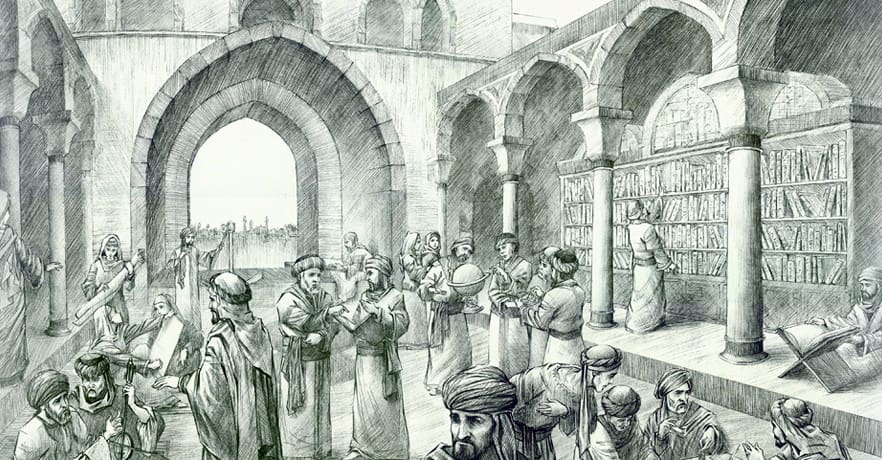
I would be remiss in writing this blog if I did not include the contributions of the larger world in the development of science and mathematics. Like the scholars and philosophers before them, the Renaissance was deeply concerned with recovering and studying the lost knowledge of the Greeks and Romans. But while Europe entered its dark ages, the Islamic world was experiencing a Golden Age of medicine, science, education, diversity, and religious tolerance. Lasting from the 8th to 14th century, this period featured the founding of the House of Wisdom in Baghdad to function as a public library. It housed rare books and was emphasized as a center for public education. The government funded their scholars, considering them to be nigh invaluable. They put considerable effort into acquiring and translating texts from Greek, Persian, and Sanskrit into Arabic, later into Hebrew and Latin. They factored diverse contributions into their collection, inviting Christian, Jewish, and Muslim scholars from around the world to disseminate and assist.
China, likewise, was experiencing an economic and cultural boom during Europe’s fractured Middle Ages. After the fall of the Han Dynasty in 220 C.E., the Silk Road trade routes suffered as there was no longer a stable empire in place to guarantee safety for long routes. It would be the Sui Dynasty (581-618 C.E) that forcibly reunified China and established the Grand Canal to link the Northern and Southern river systems, making trade routes sustainable again. This laid the groundwork for the Tang Dynasty’s Golden Age, which saw a considerable rise in artistic endeavors, civil service, cosmopolitan culture, and Buddhist ideology. The Song Dynasty (960-1279 C.E) brought about great innovations as China perfected gunpowder, printing, paper money, and the magnetic compass, all of which would have profound effects on the country’s expansion in the following century.
Renaissance: Humanism and Progress
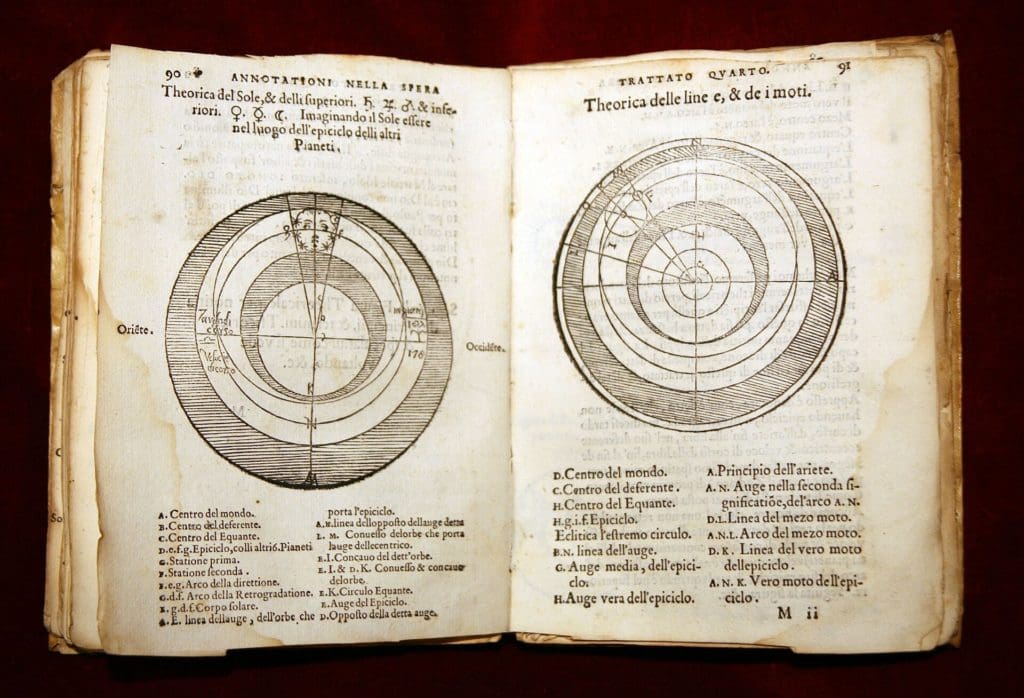
When we think of the renaissance in Europe, we see a golden age of enlightenment. A time during which advancements in science and mathematics allowed us to surge forward into a new era of questioning our surroundings. This is true, but it did not occur entirely without opposition. For centuries scholars and philosophers had devoted their studies to what had come before. Reconstructing the wisdom of antiquity and translating ancient texts to recover knowledge that was lost to us after the fall of Rome. For many, these texts were sacrosanct. To question them was heresy. In part because most people in the medieval era did not have the education or access to knowledge that would allow them to question it.
While the medieval scholars were consumed with recovering what was lost, the renaissance focused on proving what existed and theorizing what was possible. From this grew the Humanist movement, a vested belief in intellectual and cultural education for the citizenry that would allow them to lead a good civic life and improve their ability to think and act with virtuous intent. Their goals sought not only a better educated population, but well educated, morally upright leaders who would be capable of taking humanity forward in the world. A lofty goal, to be sure, but one that showed faith in the capacity of human beings.
Around 1440, Johannes Gutenberg invented the printing press. It’s true that China had already invented movable type, advancing information and records to support an expanding empire. Gutenberg’s printing press enabled printing to go faster, allowing for a market flooded with knowledge. Knowledge that was now accessible to the general public. Literacy rates swelled from roughly 10% to over 30 % (among men) from the 13th – 15th century, bringing new thinkers and scholars into the habit of questioning.
Although often viewed as pseudoscientific in its scope, the study of alchemy (the transmutation of matter) developed. One of the main goals was to reduce a substance down to its most original form. And, if that could be achieved, it was thought that one could reconstruct its material composition into another substance entirely. I.E. Lead into Gold. During this time, a Swiss alchemist and philosopher Paracelsus (Theophrastus Bombast von Hohenheim), began to conceive of alchemy as a medical practice, likening the chemical reactions of the body to those he had observed during alchemical studies. He is often credited as the “father of toxicology”.
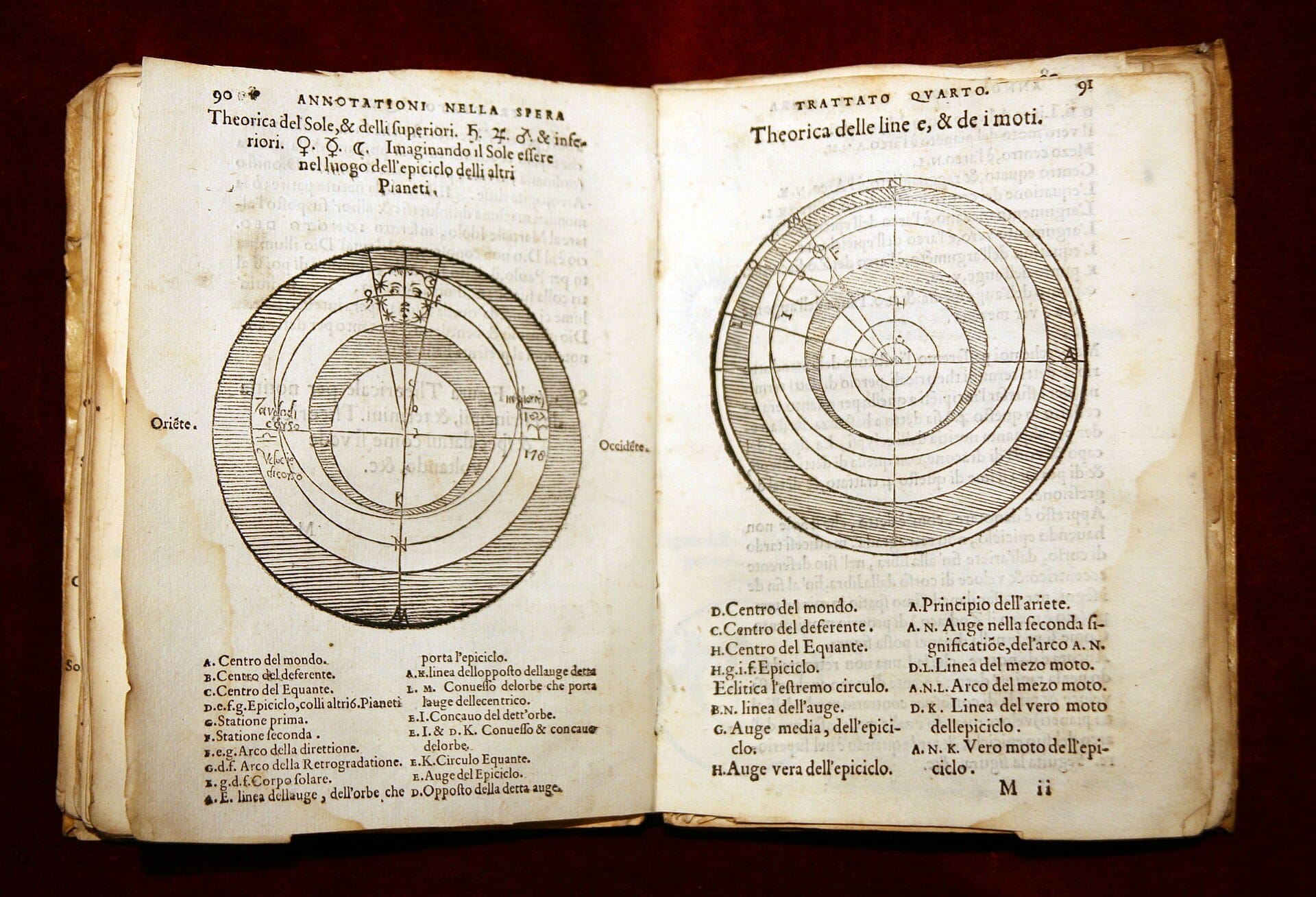
Astronomical discoveries benefited our understanding of the universe and our place in it. The work of Copernicus pioneered the heliocentric model of the universe, challenging geocentrism so staunchly applied till now. Johannes Kepler challenged the equant theory (Ptolemy philosophical idea that celestial bodies must move in a perfect circle) and provided evidence that the planets moved in an elliptical (oval) pattern. And one can hardly mention Renaissance astronomy without mentioning Galileo, who went so far as to build his own telescope (and thermoscope, and military compasses, and horse-powered water pump), with which he observed sunspots, lunar craters, the rings of Saturn and the phases of Venus. He proved Copernicus’s heliocentric universe which got him into considerable trouble with the Catholic Church as that contradicted the accepted Biblical application.
Developments in mathematics became essential as trade grew and the economy expanded. Educated mathematics was needed to ensure transaction/conversion rates, develop accurate cartography and navigation through trade routes. Islamic mathematics became crucial to the transformation of Western understanding as Hindu-Arabic numerals were brought in by Fibonacci, allowing scholars a better understanding of algebra, arithmetic, trigonometry, and a decimal place value system. All of this shifted the thinking from geometric to algebraic, allowing the early foundations of the Scientific Revolution to be laid.
COSI at the Ohio Renaissance Festival
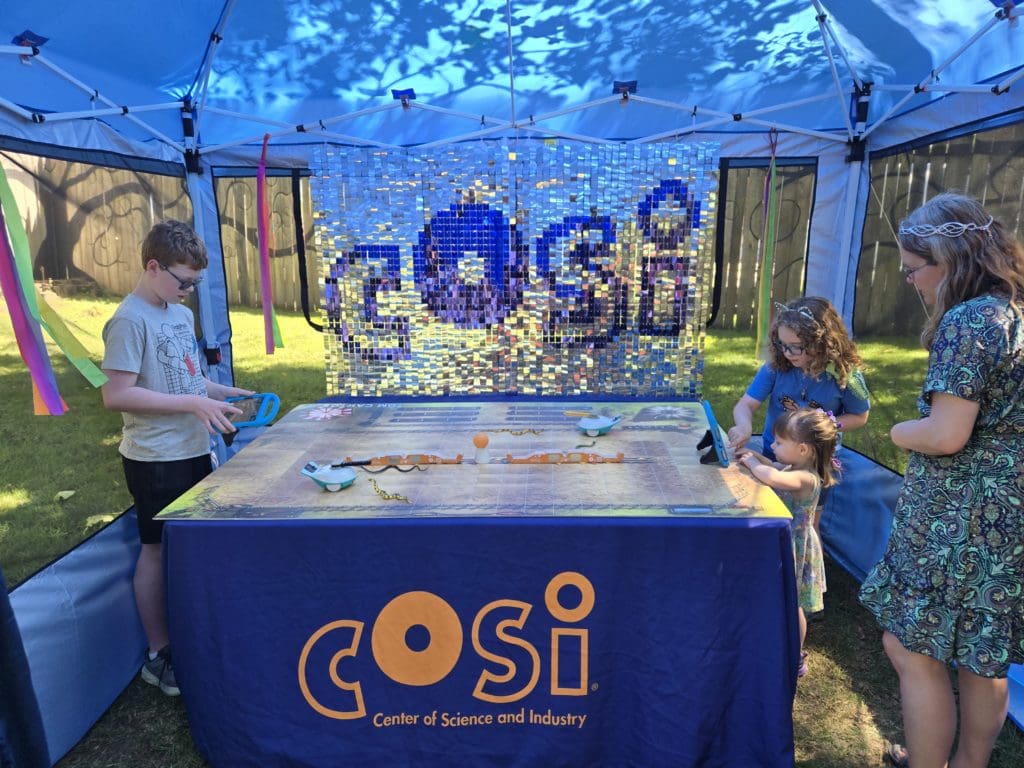
The contributions of science continue into the modern era as COSI (Center of Science and Industry) joins us at the Ohio Renaissance Festival! With their hands on brand of learning, COSI has been encouraging people of all ages to reach out and explore for over sixty years. I was lucky to grab an interview with the Director of Offsite Education Kevin Seymour, who let me know more about their learning booth in Whimsey Woods.
Q: It’s so nice to have COSI out here at the park. What makes you so vested in sharing this experience?
KS: We have a great relationship with the Ohio Renaissance Festival. They come and do one of our Adult Nights at COSI, so we come in and do some wonderful programming for the kids here at ren faire. In the past we’ve had virtual reality potion making, this year we are doing robotic jousting.


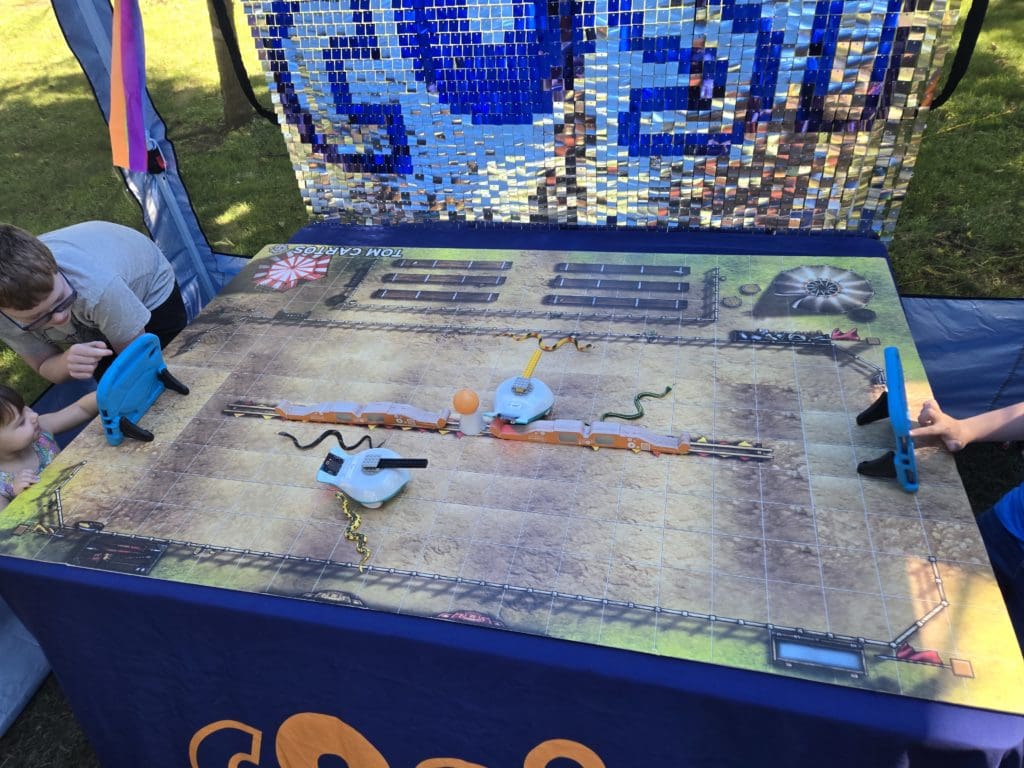
Q: Where do you think the museum of science fits in with the Renaissance theme?
KS: I think there’s science everywhere. If you’re curious and you ask questions, you’re a scientist. We want kids to be inquisitive, and what better place to do it than at the renaissance festival.
Q: Do you have any ideas for future exhibits or displays?
KS: I would love at some point to do some science about how the mythological creatures came about. Dragons, gryphons and such. That’s an exploration I would love to do for the ren faire.
Q: Is there anything that you really enjoy about being the Off-Site Educator?
KS: Every single day is absolutely different. New people, new locations, new sights and smells. I love getting sent out all over Ohio and frankly all over the country.